The End of the Black Box: Why the EU’s Radical New Pay Laws Are a Strategic Trap for the Unprepared
How the EU Pay Transparency Directive forces open the gender pay gap “black box”—from the unexplained 11.5% residual to burden-of-proof flips, AI bias, and why waiting until 2027 is a strategy risk.
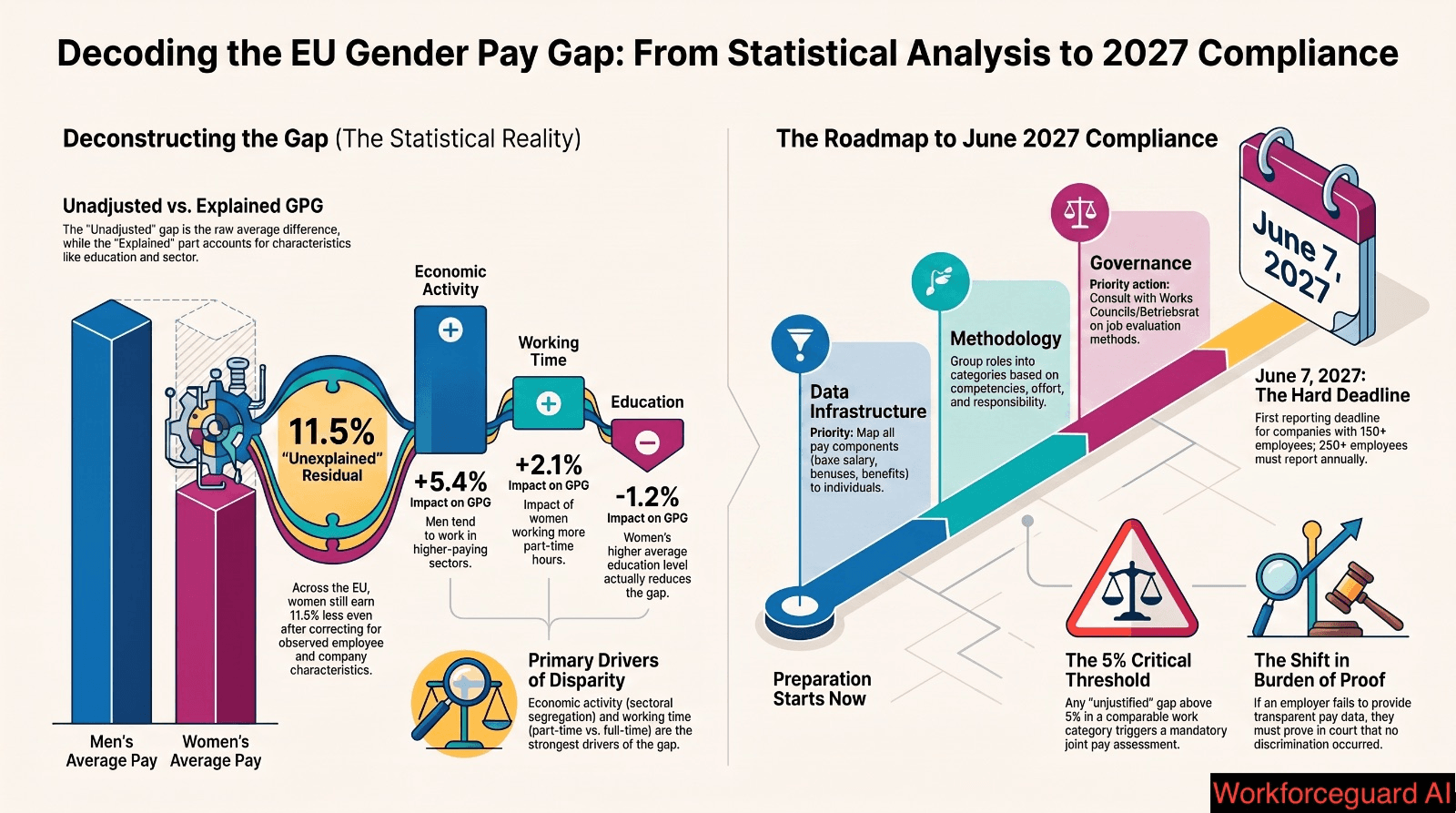
When we look at the gender pay gap, we often treat it as a single, opaque figure—a “black box” of workplace inequality. However, much like a beam of white light hitting a prism, a closer look reveals a complex spectrum of variables, structural biases, and statistical residuals. What appears simple on the surface—a single percentage—refracts into a multi-layered issue of economics, sociology, and data science as it passes through the variables of sector, education, and seniority.
For decades, the “unadjusted gender pay gap” has been the standard metric used by policymakers and HR departments. But as the European Union Pay Transparency Directive (PTD) moves from paper to practice, the traditional ways of measuring and managing pay are being fundamentally disrupted. Understanding the mechanics behind these numbers is no longer just an academic exercise; it is a strategic necessity. For modern business leaders, the “black box” is about to be forced open, and what lies inside will determine their legal and reputational standing in the coming decade.
Here are five surprising realities currently reshaping the landscape of pay equity.
1. The “Unexplained” 11.5% and the Limits of Data
At the EU level, the unadjusted gender pay gap (GPG) is 16.6%. This figure measures the relative difference between the average hourly earnings of men and women. However, through the lens of the Blinder-Oaxaca decomposition method, Eurostat data reveals that approximately 31% of the gap is explained by observable characteristics such as education, sector, and occupation. This leaves a massive “residual” known as the unexplained GPG, which stands at 11.5% across the EU28.
A critical nuance often missed by executives is that this 11.5% “unexplained” portion is a statistical residual, not a direct measurement of discrimination. The Eurostat analysis notes that the Structure of Earnings Survey (SES) fails to collect “total working experience”—tracking only tenure at the current enterprise. Because women are statistically more likely to have career breaks for childcare, this missing variable inflates the unexplained gap. As the Eurostat paper cautions:
An interpretation of the part U unexplained as discrimination is not recommended as some other explanatory factors that are not observed in the Structure of Earnings Survey (e.g. the number of children and the age of children in a family, personal abilities or negotiating skills) would most likely change the unexplained part… it seems to be more appropriate to view the part U as a ‘residual’.
For leaders, this means that even with perfect data on “explained” factors, a significant portion of the pay gap remains invisible to standard reporting, requiring deeper governance and more sophisticated auditing.
2. The Romanian Paradox: When Data Suggests Women Should Earn More
One of the most counter-intuitive findings in European pay data is the “negative explained gap” shared by 11 Member States, including Poland and Slovenia. Romania represents the extreme end of this regional trend.
In Romania, the unadjusted pay gap is low (4.5%). However, the decomposition reveals a startling reality: based on their characteristics—such as significantly higher average education levels and presence in better-paid occupations—women in Romania are actually expected to earn 12.7% more than men.
This “self-selection” effect means that in these markets, the female labor force is often more highly qualified than the male workforce. Yet they still face an overall pay gap because the “unexplained” factors are so strong they negate the women’s superior professional profiles. This paradox proves that simply hiring “better” or “more educated” talent is not a solution to pay equity; the structural logic of the pay system itself is often the culprit.
3. The Radical Shift in the “Burden of Proof”
The EU Pay Transparency Directive is moving the market from voluntary transparency to a high-stakes legal framework. Article 18 of the Directive introduces a profound “Liability Shift.” Traditionally, the burden was on the employee to prove they were a victim of discrimination. Under the new Directive, if an employer fails to meet transparency obligations (such as reporting on gaps or providing information on pay levels), the burden of proof flips.
While this “presumption de jure” feels radical, it is actually the codification of 35-year-old case law. The 1989 Danfoss case first established that when a pay system is totally lacking in transparency, it is for the employer to prove their practice is not discriminatory. The new Directive simply turns this judicial precedent into a strategic trap for the unprepared. If your organization cannot produce documented, gender-neutral criteria to justify a pay difference, the law will now assume you are guilty of discrimination.
4. Why Pay Equity is the Secret Weapon Against AI Bias
As companies increasingly rely on automated systems for recruitment and salary setting, pay equity is becoming the blueprint for fighting algorithmic discrimination. Research from the Ljubljana Law Review highlights that the challenges found in pay discrimination—specifically a lack of transparency—are identical to the “Black Box Challenge” in AI.
The Pay Transparency Directive serves as a model for auditing AI for two main reasons:
- The Black Box Challenge: AI systems are often too complex for humans to understand their internal logic. The PTD’s requirement for “objective, gender-neutral criteria” forces companies to unpack these algorithms or face liability.
- Proxy Discrimination: Algorithms often use “proxies” (like a candidate’s zip code or specific education history) that correlate with protected classes, hiding bias. By mandating transparency in the output—the actual pay—the PTD acts as a safety net to catch bias that proxy variables might otherwise obscure.
5. “Wait and See” is a High-Risk Strategy
With the June 2026 deadline for national transposition approaching, many management teams are waiting for finalized local laws. This is a risk, not a strategy. While the national laws must be in place by June 2026, the first mandatory public reports for companies with 150+ employees are due by June 7, 2027.
The work required to be ready for 2027 is immense. Organizations must define “Comparable Work Categories” based on four specific pillars: competencies, effort, responsibility, and working conditions. You do not need a final local law to begin this structural audit. As Deloitte warns:
Waiting may feel safe. In practice, it is a risk – not a strategy… You do not need the very last article of local law to start working on job architecture, worker categories, data quality, and reward governance.
Transparency is becoming a decisive factor in the labor market. Organizations that proactively adopt these structures will have a competitive advantage in attracting talent, while laggards will face both legal exposure and a “brain drain” of top-tier professionals seeking fair environments.
Conclusion: From Reporting to Governance
The shift occurring across Europe is fundamental. Pay equity is moving from a periodic “compliance report” to a permanent “structural governance requirement.”
As we move toward the 2026 transposition, the central question for every executive is no longer just “What is our pay gap?” but rather: Could your current salary logic survive a cross-examination where the law assumes you are guilty until proven innocent?