Why Restaurants Still Lose Tickets at Rush (And How I Replaced Paper with a Unified Queue)
A look at how paper tickets and siloed delivery tablets break down during kitchen rushes, and how I built MaSoVa to unify POS, aggregator, and fiscal queues into a single real-time Kitchen Display System.
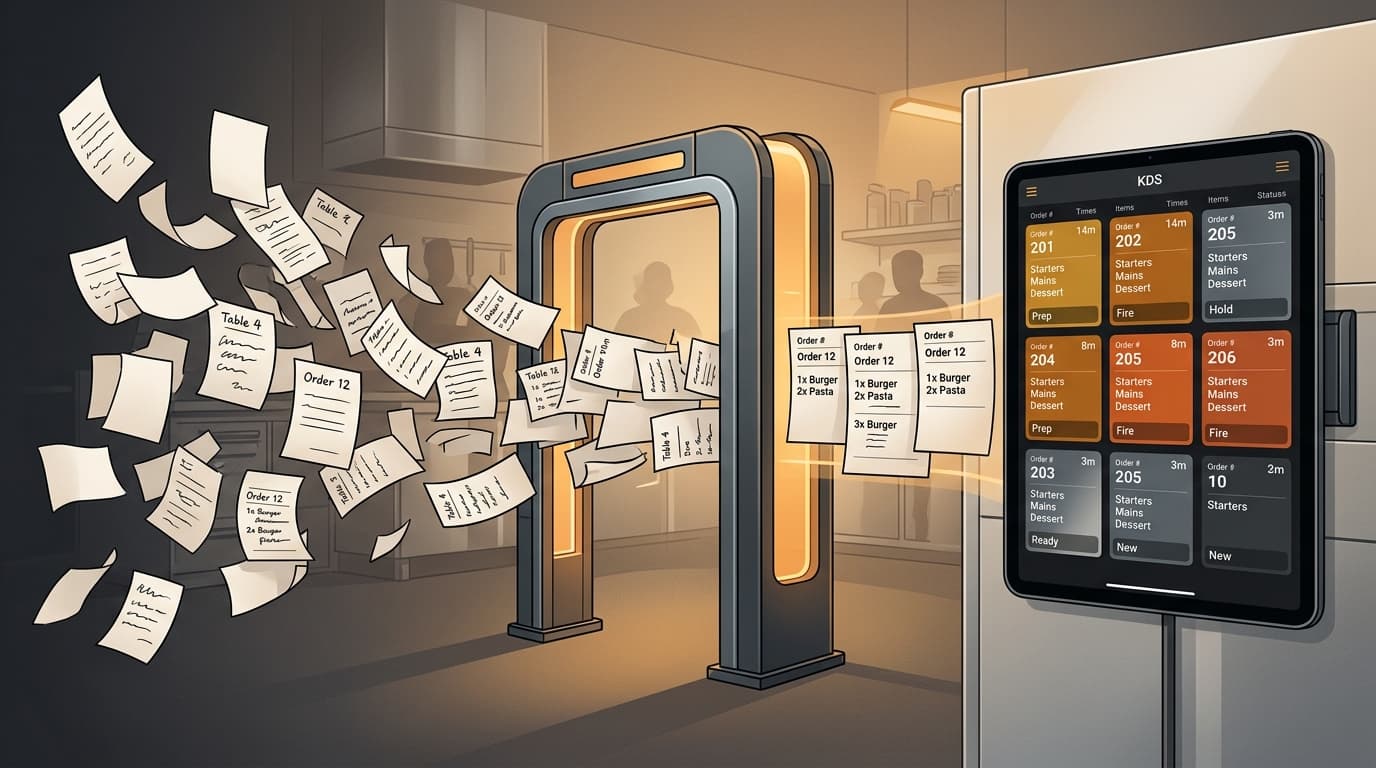
I still remember standing at the pass during a Friday night dinner rush at a bustling bistro in Munich, watching the exact moment the kitchen lost control. It was 8:15 PM. The dining room was packed, walk-ins were queuing at the door, and three different delivery tablets near the bar were chiming with entirely different ringtones. A thermal printer under the pass was screaming, spitting out long, curling ribbons of paper.
Then, a classic kitchen failure happened. A grease-stained paper ticket for Table 4, containing a medium-rare ribeye and a vegan risotto, slipped off the metal rail and fell behind a hot fryer. Nobody saw it drop. To the line cooks, that ticket simply did not exist. Twenty minutes later, Table 4 was still waiting, the delivery drivers were crowding the entrance, the manager was comping drinks to appease angry guests, and the head chef was screaming at the line.
I built MaSoVa to put an end to this operational nightmare. MaSoVa is a multi-tenant restaurant operating system that unifies in-store POS tickets, kitchen display screens, third-party delivery aggregator orders, and fiscal-safe ledgers into a single, real-time kitchen queue. It is designed so that restaurant managers, head chefs, and line cooks are no longer drowning in paper, while delivery partners get accurate handoff times and fiscal auditors get mathematically verifiable, country-compliant tax logs. By replacing the fragile physical trail with a reliable, event-driven state machine, I wanted to make sure that a busy night never again results in a dropped order.
The Fragility of Paper on the Line
Why does a modern, high-tech kitchen still rely on paper tickets? On the surface, paper seems perfect. It is cheap, highly tactile, requires zero training, and can be scribbled on with a sharpie. Chefs love paper because they can physically move a ticket from the "incoming" slot to the "prep" slot, and finally tear it in half when the dish is plated.
But paper has zero state management. If a paper ticket gets wet with sauce, it becomes illegible. If a gust of wind from the kitchen door blows it off the rail, it vanishes. More importantly, paper creates a massive information asymmetry. The front-of-house staff has no idea how far along the kitchen is with Table 4 unless they physically walk up to the pass and ask. The delivery driver waiting outside has no real-time status update. The manager looking at the POS screen only knows that the order was placed, but has no data on whether the prep has started or if the line is running twenty minutes behind.
When you add third-party delivery services like Wolt, Deliveroo, or Uber Eats to the mix, this fragile system collapses entirely. Most restaurants end up with what I call "tablet hell": five different proprietary screens mounted on the wall, each requiring manual entry of the order into the main POS just to get a printed ticket. The human cashier becomes a manual data-entry router, translating screen data to paper, which introduces massive room for typos, forgotten modifiers, and delayed starts.
Designing the Unified State Machine
To solve this, I knew I had to eliminate the paper printer and the isolated tablets, replacing them with a centralized Kitchen Display System (KDS). But doing this meant I had to model the restaurant order as a strict, event-driven state machine.
In MaSoVa, an order is not just a database row; it is a live entity that goes through a strict 11-stage lifecycle. Whether an order comes from a walk-in customer at the physical POS, an online customer using the mobile app, or an external delivery aggregator API, it is normalized into a single canonical JSON model. This payload lands in our core commerce services and immediately publishes an event to our RabbitMQ order exchange.
type OrderState =
  | "RECEIVED"
  | "ACKNOWLEDGED"
  | "PREPARING"
  | "READY"
  | "HANDED_OFF"
  | "COMPLETED";
This architecture changes everything for the kitchen staff. Instead of looking at three different screens and a physical ticket rail, the line cooks look at a single Kitchen Display System (KDS) web app running on an iPad or an industrial touch monitor. The KDS subscribes to the order events. The moment a customer pays or an aggregator confirms an order, a digital ticket card appears on the screen, sorted by exact chronological receipt time and priority.
When a cook touches a card on the screen to start prepping, the order state transitions to PREPARING. This transition immediately sends an event back to the server, which alerts the delivery driver's mobile app and updates the front-of-house host. When the meal is plated, another tap transitions the state to READY, notifying the expeditor. No paper, no screaming, and no lost steps.
The Fiscal Compliance Trap
However, building a real-time kitchen system in Europe comes with a major technical hurdle: fiscal tax compliance. Countries like Germany (with KassenSichV) and France (with NF525) have incredibly strict laws designed to prevent tax evasion. Every single transaction, modification, and cancellation must be cryptographically signed and logged to an unalterable financial ledger at the exact moment it occurs.
In a naive system design, you might try to run the fiscal signing synchronously when an order is created. But cryptographic signing takes time. If a third-party API is slow, or if the local hardware security module (TSE) takes a second to return a signature, the POS screen freezes, or the kitchen display experiences lag. During a high-volume rush, even a 500-millisecond delay per order will cause a queue backup that frustrates staff and slows down service.
I solved this by decoupling the real-time visual queue from the compliant fiscal ledger. I write the relational, financial, and tax-critical data synchronously to a PostgreSQL ledger. Meanwhile, the operational order states, menu details, and rapid-fire KDS updates live in a flexible MongoDB cluster.
Closing
Paper is not romantic when it costs tickets, comps, and trust. A unified queue does not remove the heat of service — it removes the class of failures that only show up when the pass is on fire.
Related articles
From The Compliance Glasshouse