Why Managers Still Lose the Dinner Rush on Three Tablets
An engineering field note detailing how MaSoVa unifies fragmented POS and delivery aggregator workflows using an append-only local SQLite ledger, tenant isolation, and a manager-approved demand forecasting agent.
It is Tuesday morning at 10:00 AM in a bustling multi-unit restaurant group, and the operations director is attempting to reconcile three separate tablet dashboards, a spreadsheet of last week's labor hours, and a stack of paper delivery receipts before the lunch rush hits. When a customer orders through a third-party aggregator while another transaction clears the local point-of-sale terminal, discrepancies in channel mix, inventory levels, and ticket fulfillment routinely slip through the cracks. In high-volume food service, losing a ticket or mismanaging prep quantities is rarely a simple human error; it is an architectural failure rooted in fragmented data surfaces and synchronous network bottlenecks.
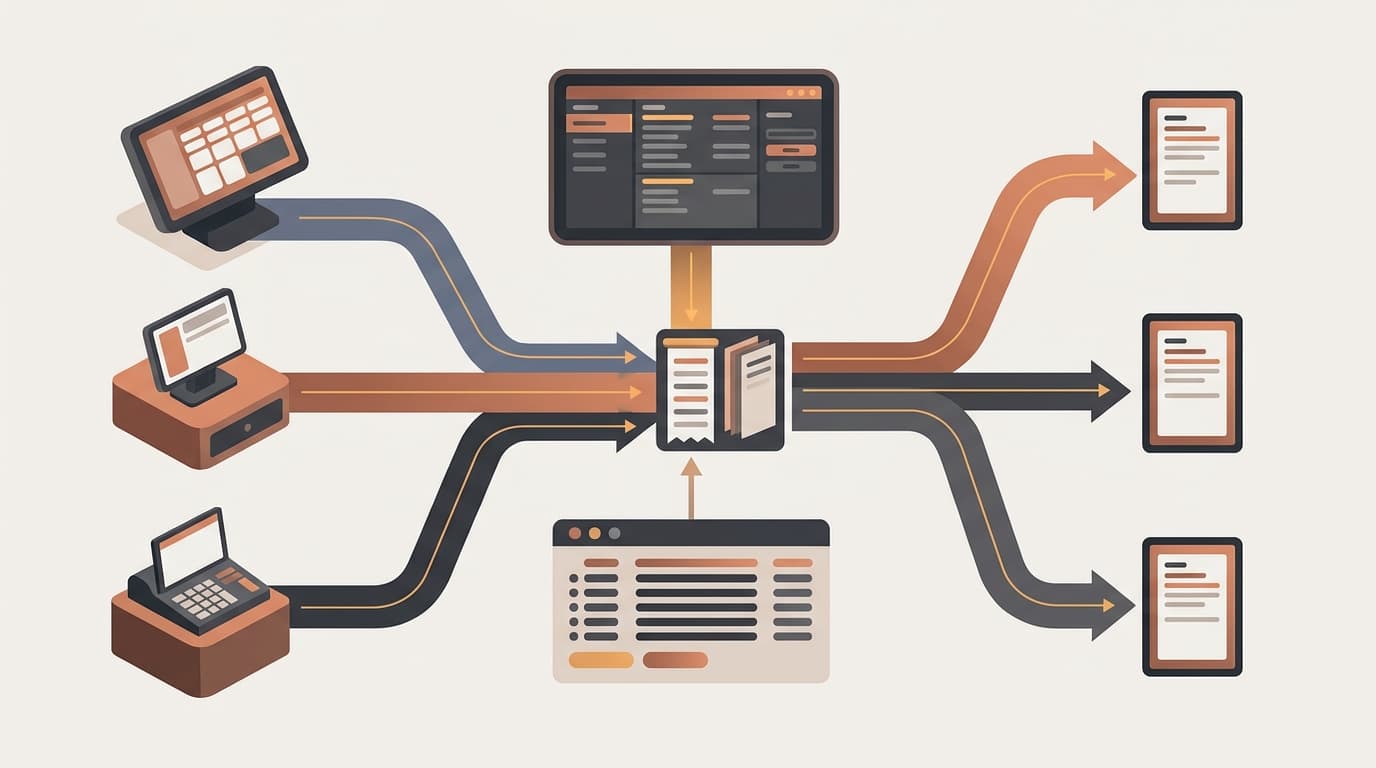
MaSoVa is a multi-tenant restaurant operating system designed for managers, shift supervisors, and multi-store owners who need to run their houses without drowning in tablet pile-ups and spreadsheets. It unifies POS tickets, kitchen displays, delivery aggregator orders, and fiscal-safe ledgers into a single control surface, ensuring the line is never left drowning in paper or broken API webhooks.
The Anti-Pattern: Tablet Piles and Disjointed State Engines
Standard restaurant tech stacks rely on decoupled silos: one proprietary terminal for in-house dining, separate tablets for delivery aggregators like Uber Eats and Deliveroo, and a separate manual ledger for inventory tracking. Each channel maintains its own local state, leading to race conditions during peak hours. If an aggregator order arrives while the local network drops or a terminal blocks waiting for an external payment gateway, the order state can diverge between the point of sale and the kitchen display system (KDS).
Furthermore, managers are forced to jump between administrative screens to check basic metrics. A manager evaluating real-time revenue cannot simultaneously view item-level inventory depletion or channel mix without manually exporting and merging CSV files. This fragmentation creates blind spots where stockouts go unnoticed until an order is already paid for and canceled.
Architectural Mechanisms for Unified Operations
To eliminate ticket loss and provide a trustworthy control surface, MaSoVa implements three core engineering mechanisms:
-
Unified Order Normalization Pipeline: All inbound transactions—whether originating from an in-house POS terminal or an external delivery webhook—are funneled through a strict normalization schema. We use an append-only SQLite WAL (Write-Ahead Log) file on the local LAN to transition orders reliably through deterministic states (
RECEIVED->LOCALLY_QUEUED->PREP) without blocking on cloud confirmation. -
Multi-Store Isolation: Multi-unit operators require strict boundaries between locations. We enforce tenant isolation at the database layer using scoped partitioning keys, ensuring that menu configurations, staff permissions, and analytics for one storefront never leak or cross-contaminate adjacent locations.
-
Centralized Manager Dashboard & Asynchronous Aggregation: The manager dashboard aggregates revenue, channel mix, inventory depletion, and labor metrics into a single control surface. Rather than querying transactional databases synchronously, background worker threads batch and rollup metrics asynchronously, keeping UI read paths fast and responsive even during Friday night rushes.
AI Trace: Demand Forecasting Under Human Approval
While real-time state management keeps the kitchen running, inventory waste remains a persistent margin killer. MaSoVa incorporates a demand forecast agent that analyzes historical sales data, local weather inputs, and seasonality to suggest item-level prep quantities. Crucially, this agent operates strictly as a recommender. It writes its output to a staging table that requires explicit manager approval before any prep lists or inventory reorder thresholds are updated. The model provides a helping hand under strict human evidence constraints, never automatically altering active kitchen instructions or fiscal records.
Operational Trade-Offs and Edge Risks
Operating a local-first ledger with cloud synchronization introduces distributed systems trade-offs. If a local LAN loses power mid-rush, the local SQLite ledger maintains operation via battery backup, but conflict resolution policies must be carefully tuned when reconnecting to the cloud database. We chose a last-write-wins strategy keyed on client-side monotonically increasing sequence numbers for configuration changes, while order creation relies on immutable append logs to prevent double-billing or dropped tickets.
Operational Context & Resources
Related articles
From The Compliance Glasshouse